From Vision to Enterprise Capability
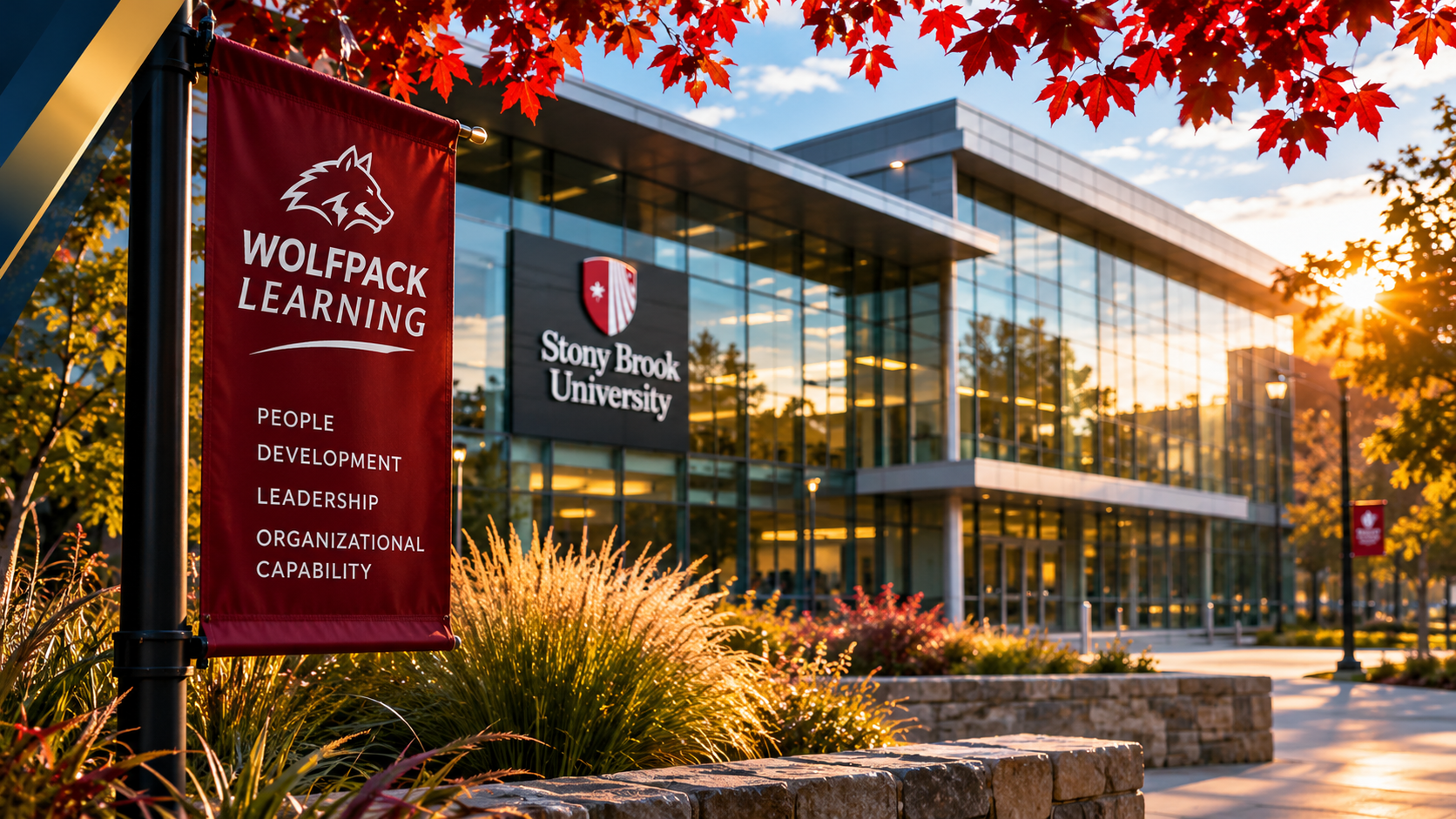
Stony Brook University | 2024–Present
Executive Strategy • Organizational Development • Leadership • Institutional Transformation
The Opportunity
At Stony Brook University, an AAU-member, R1 research institution, the challenge was to develop a cohesive learning and development capability serving a workforce of more than 17,000 employees.
The university’s diverse academic, research, healthcare, and administrative functions required an approach that could accommodate specialized workforce needs while strengthening institutional alignment.
The opportunity extended beyond delivering training. It was to establish an enterprise capability that could develop leaders, strengthen employee performance, support organizational change, and promote continuous learning.
My Strategic Approach
As Manager of Wolfpack Learning within Human Resources, I led the development of a learning and development function designed around institutional priorities and measurable service delivery.
My approach centered on five strategic objectives:
- Build the infrastructure. Establish the Wolfpack Learning identity, operating practices, service channels, and processes necessary to support enterprise learning.
- Strengthen the employee experience. Redesign new employee orientation to connect team members with the university’s mission, culture, resources, and expectations.
- Develop leadership capability. Expand supervisory training and establish tailored leadership development academies.
- Build strategic partnerships. Create learning alliances and cross-functional relationships that extend expertise beyond organizational boundaries.
- Advance innovation. Establish Wolfpack Skunkworks to explore emerging learning technologies and advanced human-performance challenges.
The underlying philosophy was straightforward: learning and development should function as a strategic organizational capability, not simply a provider of courses.
From Strategy to Execution
Working with the Wolfpack Learning team and university stakeholders, I helped translate this vision into an operational portfolio.
The work included launching an expanded Supervisory Success Program, redesigning New Team Member Orientation, developing leadership academies for university departments, and establishing professional learning networks.
We also introduced digital learning resources, service-intake processes, coaching initiatives, and partnerships supporting broader institutional development.
The result was an integrated approach connecting foundational employee learning with leadership development, organizational collaboration, and strategic innovation.
Documented First-Year Impact
17,000+ — University workforce served by the learning and development function.
1,436 — New Team Member Orientation attendees.
1,386 — Supervisory training instances.
63 — Leadership academy participants across five cohorts.
114 — Learning leaders engaged through professional networks representing 91 organizations.
219 — Organizational retreat participants supported.
These results demonstrate the scale and reach achieved during the function’s initial reporting period.
Beyond Conventional Learning & Development
A distinguishing feature of the initiative was the establishment of Wolfpack Skunkworks, an experimental learning design portfolio exploring emerging technologies and human performance in complex, high-consequence environments.
The portfolio encompasses twelve advanced learning domains, including neuroergonomics, autonomous systems, cognitive engineering, immersive environments, and post-quantum literacy.
This work expanded the strategic scope of Wolfpack Learning through advanced instructional architectures, research, proposed simulation designs, and business analysis of potential future applications.
The Executive Leadership Lesson
Building Wolfpack Learning reinforced a principle that has guided my career:
Lasting organizational impact comes from building capabilities, not merely completing initiatives.
Successful execution required strategic planning, stakeholder alignment, team leadership, business analysis, operating discipline, and the ability to connect institutional priorities with practical solutions.
The accomplishment was not simply creating new learning programs. It was establishing an organizational foundation through which people, departments, and leaders could continue developing their capabilities.
William P. Corrigan, MBA
The Executive Strategist | The Renaissance Professional