Expanding Institutional Capability Beyond Organizational Boundaries
Stony Brook University | 2024–Present
Strategic Partnerships • Coalition Building • Knowledge Networks • Organizational Innovation
The Opportunity
Organizations invest considerable resources in developing internal expertise. Yet some of their most valuable opportunities for learning emerge through relationships beyond their institutional boundaries.
Universities, corporations, and mission-critical industries face many of the same challenges: technological disruption, workforce transformation, leadership development, and the accelerating need for new capabilities.
Despite these shared concerns, learning and development professionals frequently operate within organizational and industry silos.
I recognized an opportunity to establish professional networks that could connect experienced practitioners, encourage meaningful dialogue, and expand access to ideas and perspectives that might otherwise remain isolated.
The objective was to turn professional relationships into a strategic resource for organizational learning.
My Strategic Approach
As Manager of Wolfpack Learning at Stony Brook University, I initiated a portfolio of professional learning alliances designed to bring together learning and development leaders across different institutional environments.
My approach was guided by five principles:
- Connect complementary expertise. Bring together professionals whose different experiences could illuminate common organizational challenges.
- Encourage candid exchange. Create environments where participants could discuss emerging issues, successful practices, and lessons learned.
- Organize around shared challenges. Focus conversations on workforce capability, leadership development, learning technology, organizational change, and the future of adult learning.
- Minimize barriers to participation. Establish accessible, voluntary professional communities centered on mutual benefit rather than commercial transactions.
- Create opportunities for benchmarking. Enable participants to compare approaches, examine emerging practices, and identify ideas worth exploring within their own organizations.
Rather than creating a single broad professional network, I developed three distinct communities serving different sectors.
From Strategy to Execution

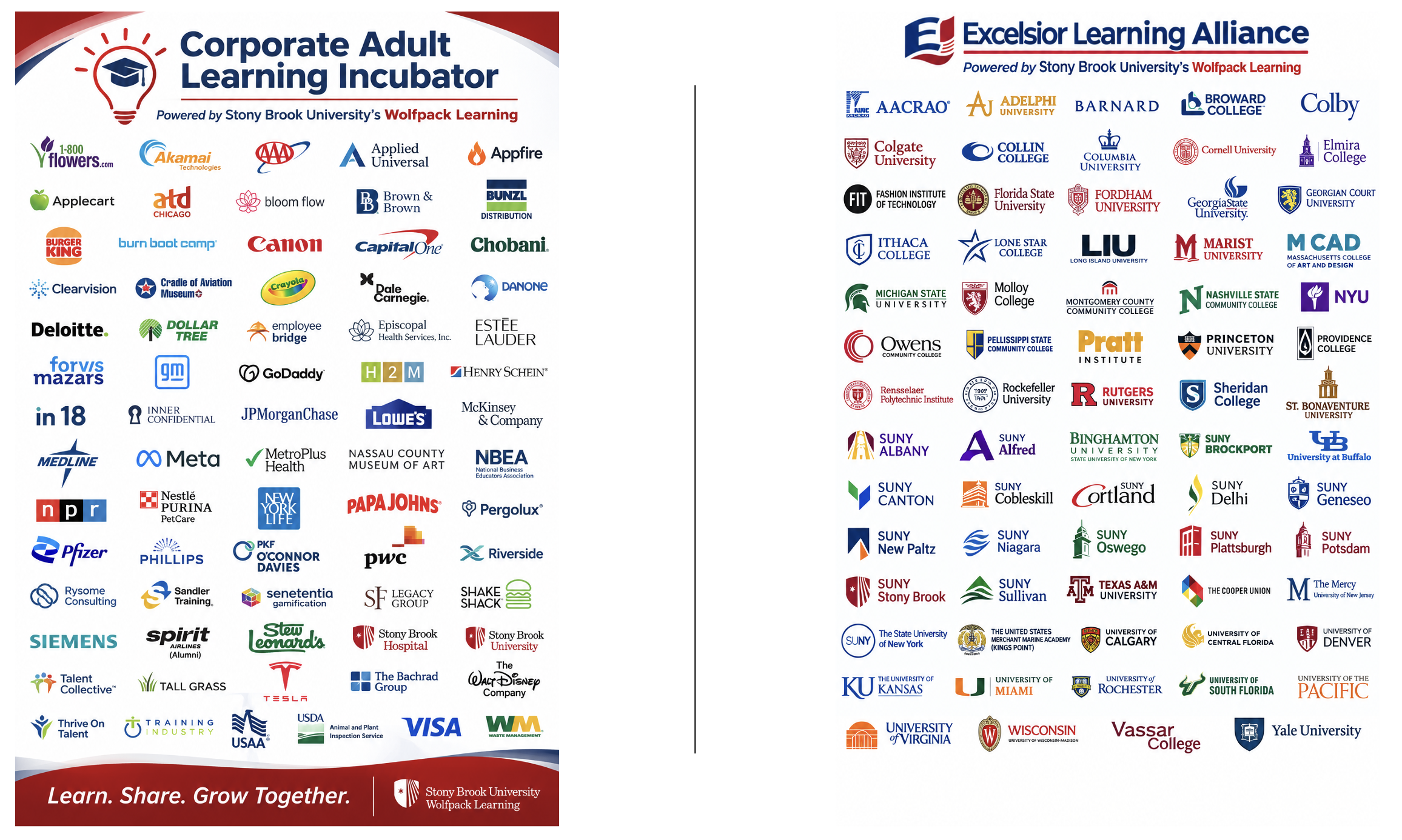
Excelsior Learning Alliance
Connecting Higher Education Learning Leaders
Launched in November 2024, the Excelsior Learning Alliance was established to connect learning and development professionals from colleges, universities, and higher education organizations.
The network focuses on challenges such as employee orientation, leadership development, compliance training, instructional design, and learning technology.
Its purpose is to encourage peer benchmarking, knowledge exchange, and collaboration among institutions that share a commitment to developing faculty and staff capabilities.

Corporate Adult Learning Incubator (CALI)
Connecting Corporate Learning Leaders
Launched in July 2025, CALI was developed as a professional community for learning and development practitioners working in corporate environments.
The network provides a forum for discussing workforce transformation, emerging technologies, organizational performance, and the evolving role of adult learning in business.
By bringing together perspectives from different industries, CALI encourages participants to examine how other organizations approach common challenges and consider practices that may be transferable to their own environments.
Patriot Learning Alliance
Exploring Learning in Mission-Critical Industries
Launched in August 2025, the Patriot Learning Alliance extends the network model toward professionals associated with aerospace, defense, energy, infrastructure, and other high-consequence environments.
Its focus includes the development of human capabilities in complex operating conditions, emerging technologies, organizational resilience, and advanced training challenges.
The alliance provides a framework for professional dialogue about learning and performance in industries where reliability, judgment, and operational readiness are especially important.
Documented Impact
269 — Learning leaders engaged through Wolfpack Learning’s professional networks.
199 — Organizations represented.
3 — Distinct professional learning alliances established across higher education, corporate learning, and mission-critical industries.
November 2024 — Launch of the first alliance, establishing the foundation for a broader professional network strategy.
These results demonstrate the initial reach of the network-building initiative and the level of interest in cross-organizational professional exchange.
The longer-term value of the alliances lies in their potential to support knowledge transfer, benchmarking, professional collaboration, and the identification of emerging practices.
Beyond Networking: Building Intellectual Capital
The strategic significance of these alliances extends beyond expanding professional contacts.
Each community represents an opportunity to bring external perspectives into institutional thinking.
A higher education learning leader may discover an effective approach to leadership development from a corporate counterpart. A corporate learning professional may gain insight from the research-oriented practices of a university. A practitioner working in a mission-critical environment may introduce new ways of thinking about human performance, risk, and decision-making.
These exchanges create opportunities for organizations to challenge assumptions and expand their understanding of what is possible.
The alliances were designed around a belief that professional knowledge becomes more valuable when it is shared, questioned, and applied across disciplinary boundaries.
The Executive Leadership Lesson
Building these strategic learning alliances reinforced a principle that has shaped my approach to organizational leadership:
The boundaries of an organization should not define the boundaries of its knowledge.
Effective coalition building requires the ability to recognize shared interests, establish trust, connect diverse stakeholders, and create a compelling reason for people to participate.
The accomplishment was not simply establishing three professional networks. It was creating a framework through which organizations and practitioners could exchange knowledge, broaden perspectives, and explore opportunities for collective advancement.
William P. Corrigan, MBA
The Executive Strategist | The Renaissance Professional